
Onondaga Previous Residents Sources
Past residents leave different kinds of evidence. County land records identify a conveyance, assessment rolls give administrative snapshots, and library sources can place a printed name near an address. Start with the source closest to the date you need. A current parcel card and deed book/page are the best bridge for an address trail. For an earlier household question, a directory, newspaper, obituary, cemetery record, or museum file may be the better opening record.
| Source | Years It Covers | Where Held | What It Shows |
|---|---|---|---|
| County Clerk deeds and mortgages | 1794-present | County Clerk and eSearch | Recorded conveyance details and legal descriptions |
| Assessment rolls and tax maps | Available by municipal roll year | Town, RPTS, and Image Mate | Parcel, assessment, owner, mailing, and deed-book references |
| Syracuse city directories | 1844-present, with gaps | OCPL and FamilySearch through 1923 | Dated directory entries that may include Town addresses |
| Telephone directories | 1894-present | OCPL Local History & Genealogy | Telephone-subscriber trail by year |
| Newspapers and obituary index | 1850 to near present; index about 1860-1996 | OCPL Local History & Genealogy | Address, family, death, and migration clues |
The table identifies a research path, not a roster. A name on a deed, assessment record, or obituary must retain its date and role before it is described as part of an Onondaga previous residents trail.
Defining Onondaga Previous Residents
The phrase previous residents can mean several things at one address: a documented owner, a person listed in a directory, a name in a census or obituary, or another source-specific association. Those labels are not interchangeable. A grantor signed away an interest. A grantee received an interest. A directory entry may be a household head, business, institution, boarder, or telephone subscriber. An assessment owner or mailing address is an administrative entry, not proof of who occupied a parcel.
Use the record language in notes. That simple practice prevents a legal transfer from being presented as a claim about who lived there before.
Onondaga Previous Residents in eSearch
The County Clerk says its real-property series begins in 1794 and that ownership may be traced when an owner is known. The free guest index at Onondaga County Clerk eSearch is the online starting point. Images and printing require an account or subscription. When an image is not available online, use the Clerk's Room 200 counter, archives and photostat contact, telephone route, or a copy request after identifying the instrument.
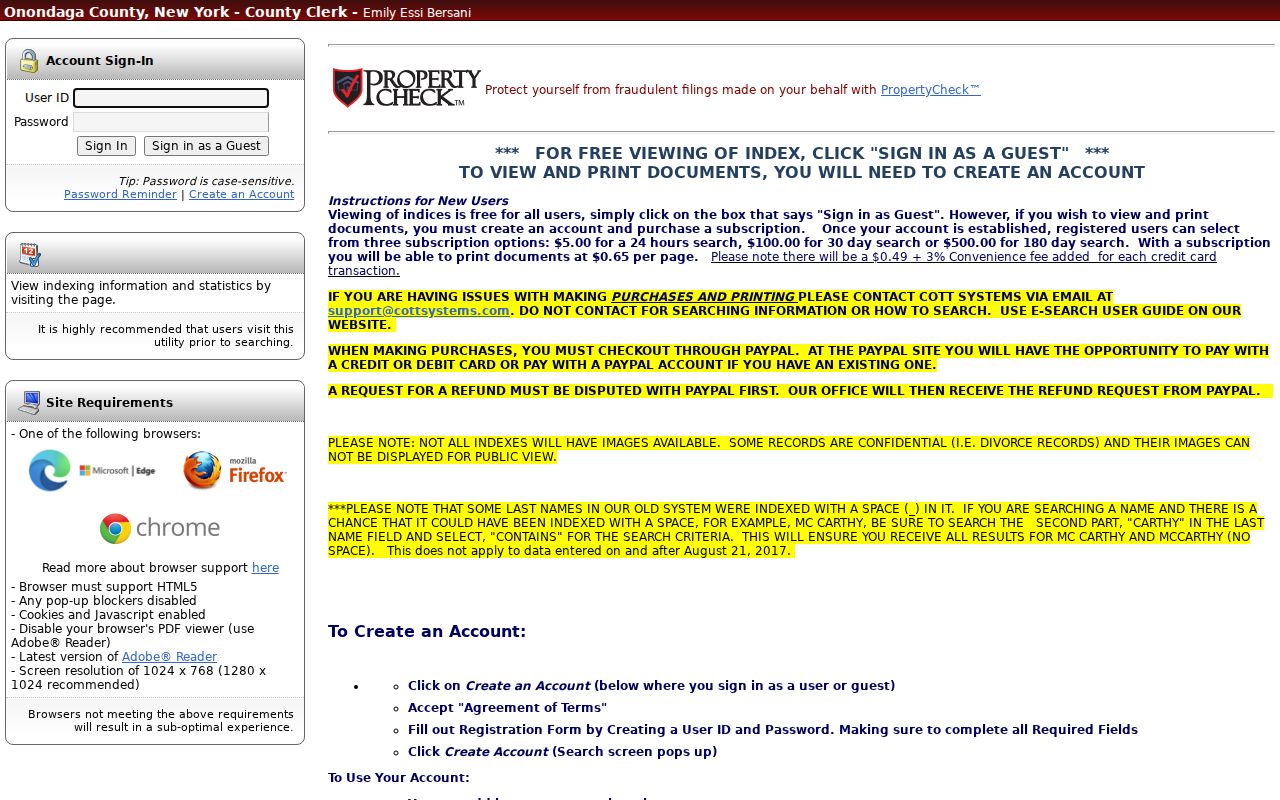
The public login view does not expose every post-login field or result column. Preserve that gap instead of assuming a keyword, export, or image option that was not documented.
For older compound surnames, the County Clerk's tip is to search the second part with Last Name set to Contains, such as CARTHY for MC CARTHY. The research notes that this tip does not apply after August 21, 2017. Handwritten index spelling and spacing variants need the same care.
Onondaga Deed Records Backward
Follow the deed chain from a stable parcel reference rather than from an entire street. The Image Mate assessment search can supply the current parcel card, owner field, tax-map number, and deed book/page. The book/page is the bridge into the Clerk index. Keep the legal description exactly as recorded before trying to match it to a modern map, because lot, tract, farm, and road terms can change.
- Open the current parcel card and copy the tax-map number, deed book/page, assessment date, and legal description.
- Find the identified purchase deed in the Clerk index and record its grantor, grantee, instrument date, recording date, book/page, and linked-image status.
- Retrieve the image through the documented online account route, a Clerk copy request, or an in-person research route when available.
- Use the grantor from that deed as a grantee search to locate the prior purchase, then copy the earlier instrument reference.
- Repeat backward while testing spelling and tract variants. Ask the Clerk archives for help when the trail reaches handwritten indexes or unclear volume references.
- Grantor / grantee
- The grantor transfers an interest; the grantee receives the interest in the recorded instrument.
- Chain of title
- The linked sequence of recorded transfers for the same legal parcel or tract.
- Legal description
- The lot, tract, block, or other recorded land description that can outlast a changed street address.
Onondaga Deed Record Limits
A County Clerk deed and mortgage description sets an important boundary for previous residents research. A deed proves a conveyance of an ownership interest. It does not describe the structures on a parcel or establish who was present there. A mortgage records financing or a security interest, not ownership or occupancy. An easement or right-of-way is an access interest, not an ownership transfer.
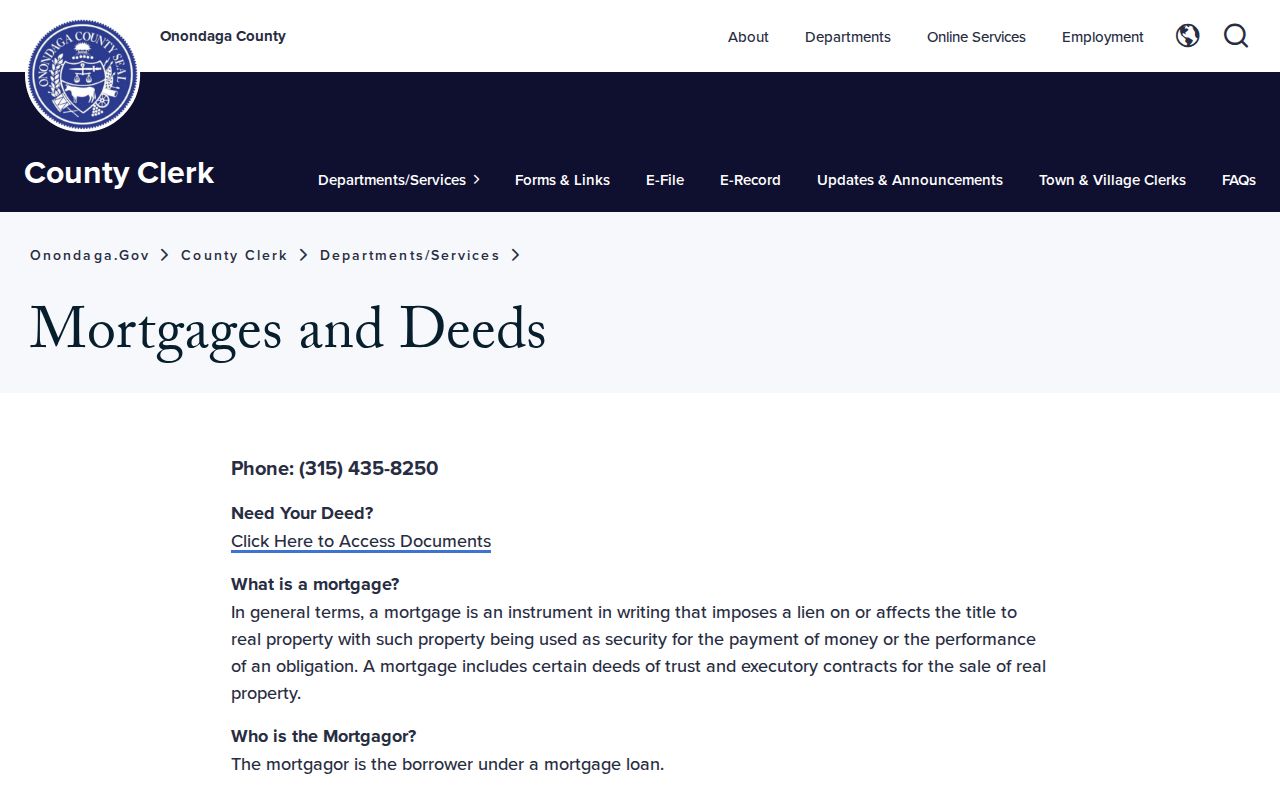
This distinction keeps the address history honest. Pair an ownership event with an independently dated directory, newspaper, census, cemetery, or museum source before describing a person as connected to a household.
Note: Recording dates and assessment dates can differ, so use the recorded instrument date as the legal event and label administrative updates separately.
Onondaga Address Record Snapshots
Assessment material helps join an old deed reference to the address used today. Typical Image Mate and RPTS cards show a tax-map parcel number, property location, current owner and mailing fields, parcel size, tax description, deed book/page, valuation and taxable-status dates, exemptions, and school or special districts. The deed book/page on the card does not open the deed image itself, but it gives the next step for the Clerk search.
Official examples show that a situs can have a mailing address on another street or in another city. Treat the property location, postal mailing field, and Town jurisdiction as separate facts. Parcel splits, mergers, road-name changes, and condominium overlap can break a simple address match. Compare annual tax maps and assessment rolls by roll year, then use the legal description to decide whether the historical parcel remains the same.
Previous Residents in OCPL Records
Ownership is only one layer of who lived here before. OCPL Local History & Genealogy holds Syracuse city directories from 1844 to the present with gaps, telephone directories from 1894 to the present, newspaper microfilm from 1850 to near the present, and an obituary index for about 1860 through 1996. A Syracuse title does not guarantee Town of Onondaga coverage. Test the exact street, a hamlet, and a county term, then compare a known Town address in the same year.
The Onondaga city directory collections resource details the shelves and formats. For an address timeline, pair each directory entry with the closest census, tax, or assessment date rather than treating the directory as a complete household list.
- Copy the name, street, number, year, page, and source format from the directory entry.
- Find the closest census, assessment roll, or tax-map year and record its date separately.
- Compare the street form and municipal label before connecting the two dated records.
- Use an obituary, cemetery, church, or Historical Society source to test a move, death, or family link.
FamilySearch lists a digitized Syracuse directory for 1881-82 as a 358-page item, and OCPL notes digitization through 1923. Record the item identifier, page, printed address, and coverage caution. Those details let a later census or obituary check the same household without turning a search result into a present-day claim. Viewer and location access can vary by item.
Onondaga Records: Syracuse Sanborn
The Library of Congress has a Syracuse 1892 Sanborn volume with 78 sheets, but direct Town of Onondaga coverage was not located. It can provide urban comparison only when the place actually falls within the mapped Syracuse area. Do not relabel it as an Onondaga Town map. County Clerk archives, RPTS tax maps, Town Museum maps, and historical association material have different coverage and should be cited by title, date, sheet, and place.
The Town newsletter also reported in Fall/Winter 2022-23 that the 1855 Town of Onondaga census had been completely indexed and was not then available on Ancestry or FamilySearch. That historical newsletter note is not a current availability claim. Ask the Historical Society or museum for the present catalog route.
Onondaga Previous Residents, Local Context
The Town Historical Society is a source for cemetery burial records, photographs, newspaper articles, census material, county poorhouse information, and family research. The museum at 5020 Ball Road holds Poor House Ledgers from the 1830s to the 1960s alongside family histories, diaries, church and burial records, maps, and photographs. Ask staff which finding aid, year range, and reproduction permission applies before requesting names or copies.
The digitized Partridge Family Collection provides a human-use bridge from address paperwork to family context. Its more than 350 items include deeds, mortgages, receipts, letters, school essays, migration correspondence, and town-commissioner documents. A collection item can suggest an address or relationship, while the County Clerk instrument and a dated directory entry test the connection.
Lawful use. Use Onondaga previous residents records for family history, estate work, house history, and personal research. Do not use a dated record to track, harass, or harm a living person.
Where Onondaga Address Records End
Some gaps are normal. The County's electronic land-record system launched in 2017, and a capital-project narrative describes digitizing remaining mortgages from 1794 through 1950 and numerical deed and mortgage indexes from 1799 through 1986. The narrative says work began in September 2022 and expected completion in December 2024. Check eSearch record by record rather than assuming those target dates mean every image is now online.
The County Clerk's 2024 annual report, published in 2025, counted 125,316 transactions and 275,003 land pages entered countywide. That scale explains why a Town request may move through a county system, but it is not a Town population or address statistic. An address chain can stop at a missing directory volume, a rural or hamlet omission, a name variant, an older legal description, a parcel change, or a source available only through staff, library, archives, or museum inquiry.