
Finding Onondaga Resident Records
No single master list of Onondaga households exists. The best route depends on what detail you hold. An exact street address belongs first with the assessment roll and the parcel map. A full name plus a past year fits library directories, newspapers, and family files better. A tax-map number or a deed book and page points straight to the County Clerk. Each result answers a narrow question, such as recorded ownership or a dated directory entry. None of them proves on its own that a person lives at an address today. Every Onondaga residents directory result is only as strong as its source and its date.
Keep the record type visible as the search moves along. Onondaga has a postal trap worth knowing. Town Hall and many town offices carry a Syracuse, New York 13215 mailing label. Yet that label is not City of Syracuse jurisdiction. Confirm the true municipality through the parcel. Use the tax-map number, a GIS layer, or the town office. For older names, try the Town of Onondaga, a hamlet, and Onondaga County alongside Syracuse in the library catalog.
- For an address, use the county assessment search and record the situs, mailing field, tax-map ID, roll year, and deed book/page.
- Open the GIS parcel view to check the municipality and surrounding parcel geometry before treating a postal city as a jurisdiction.
- Use the County Clerk index for the recorded document trail, then ask the Clerk about an image or copy when the index is not enough.
- For a past household, ask OCPL Local History & Genealogy for the appropriate directory, telephone-book, obituary, or newspaper run.
- Request an existing town or county record by series, address, and date range when no online index covers it.
Note: A no-result can stem from a spelling variant, a coverage gap, a sealed record, or an index entry with no image attached.
Onondaga Offices Behind Resident Records
Several custodians hold different pieces of the Onondaga record trail. The Town assessor settles local parcel and assessment questions. The County Clerk keeps the land records and their index. The Board of Elections runs election records and the state lookup. The Town Clerk manages municipal files and the Town FOIL route. That division shapes every search. An Onondaga residents directory search should begin at the office that created the record. Ask another office to assemble a fresh resident list, and you will wait. For an address-by-address approach, use the Onondaga street directory.
Onondaga County Clerk
401 Montgomery Street, Room 200
Syracuse, NY 13202
315-435-8250, Real Property
Onondaga County Board of Elections
1000 Erie Boulevard West
Syracuse, NY 13204
315-435-8683
Onondaga Parcels Before Names
The county's Image Mate assessment search is often the cleanest first stop for an address. Its own guidance says to enter one search item, then refine from there. A parcel record can yield a tax-map number, owner of record, situs address, owner mailing address, assessment data, and a deed book and page. Verify locally with the Town assessor. County information comes from the towns, and it can change during the year.
| Image Mate field | How to use it in Onondaga |
|---|---|
| Tax Map Number | The strongest stable parcel key when an address has changed or a name is common. |
| Owner Name | Enter the name as the deed or roll shows it, then test a surname variant if needed. |
| Property Address | Use the physical situs, not a mailing address, to begin an address search. |
| Mailing Address | Labels a delivery address for the owner and must not be treated as the parcel location. |
The parcel card is a dated assessment snapshot. It may show an owner field. It does not list every person at the property. The deed book and page serve as the bridge to the Clerk's index.
Onondaga Deed Index Trail
The County Clerk eSearch offers a free guest route into its index. Document images require an account, a subscription, or a counter copy request. Not every historic index entry has an image. Recorded land records reach back to 1794. That span is a gift for estate and family-history work, but it is not one modern address search. Older entries lean on names, legal descriptions, book and page references, and handwriting that reward patient variant searching.
A deed records the transfer of an interest. It is evidence of a dated ownership event, not a census of occupants. A mortgage records financing, and an easement or right-of-way transfers no ownership at all. A compound surname may seem absent. The Clerk's published tip is to try the second component with Last Name set to Contains, subject to the stated post-August 21, 2017 limitation.
- Parcel
- A tax-defined piece of land identified by a tax-map number, not a list of everyone who lives there.
- Grantor and grantee
- The party transferring an interest and the party receiving it in a recorded document.
- Index
- A finding tool that points to a record. It may not include the document image.
- Criss-cross directory
- A historical directory arranged by address, useful for dated household research when a library holds one.
Onondaga Voter Records Have Limits
The state voter lookup asks for county, last name, first name, date of birth, ZIP code, and address information. It exists for an individual's registration and polling details. It is not for building a household roster. Election Law §3-220 keeps registration records public under Board supervision. The same law closes driver-license, non-driver ID, Social Security, and facsimile numbers.
Treat any return as limited, dated civic corroboration. A result can be stale, protected, or changed by list maintenance. Record the access date. Skip the protected identifiers. Ask the Board of Elections about an existing report or district record when the online answer falls short.
Current Onondaga Resident Sources
Current-looking sources still differ in scope. Assessment records organize land and ownership. The voter service handles one individual's registration. The Clerk index organizes parties to recorded documents. Court, license, jail, registry, and business sources each serve another purpose, and any of them may hold a name without showing current residence. An Onondaga residents directory search stays accurate when the source label rides beside the name and date. No source promises that every household can be found.
| Source | Who It Lists | Keeper | Access |
|---|---|---|---|
| Image Mate roll | Assessment owner and parcel fields | Town assessor / county display | Public search, verify locally |
| NYS voter lookup | Limited individual registration and polling information | Board of Elections | Public lookup with field limits |
| Clerk eSearch | Grantors, grantees, and recorded document parties | Onondaga County Clerk | Guest index free; images limited |
| Town records | Existing minutes, permits, clerk files, and notices | Town departments and Clerk | Department, counter, or FOIL route |
| Public-safety tools | Time-sensitive custody or statutory registry information | Sheriff or state agency | Restricted by purpose and rules |
Pick the tool that fits the question. Assessment rolls answer parcel questions. The County Clerk answers recording questions. A library answers questions about households at a fixed point in the past. When two Onondaga records might describe the same person, the Onondaga resident lookup approach keeps dates, name variants, and address types from blurring together.
Onondaga Names at OCPL
OCPL Local History & Genealogy is the backbone for anyone tracing old Onondaga households. The Central Library room keeps Syracuse directories running from 1844, though some years are missing, and telephone directories from 1894 onward. Microfilmed newspapers, an obituary index, WPA files, the Onondaga Pioneer Index, and family vertical files round out the shelf. Ask by town, hamlet, county, or street. A Syracuse label alone can mislead you here.
Format drives the plan. Directory volumes from 1844 to 1860 sit on microfiche. The 1862 to 1935 run is on microfilm, and paper volumes cover 1936 forward. Anything through 1923 also has a FamilySearch digitization route. A directory entry proves only the volume year and the printed address, so treat it as a record of its moment rather than proof of where a person lives now.
Onondaga Museum Family Trails
The Town of Onondaga Historical Society holds material no residents directory ever printed. Its museum inside Town Hall collects family histories, burial and church records, maps, diaries, scrapbooks, photographs, and Poor House Ledgers. Those ledgers span the 1830s to the 1960s. Requests land best with a full name and its variants. Add a rough year, a hamlet or street, and one narrow question. Get permission before reproducing anything.
The digitized Partridge Family Collection connects paper documents to real family lines. More than 350 items survive. Deeds, mortgages, receipts, letters, school essays, and town-commissioner papers all sit in it. The collection can point a researcher toward a name or an event. But pair it with a Clerk document or another custodial record whenever you need legal confirmation of what it shows.
Onondaga Court and Vital Checks
Court and vital records verify names. They are not household lists. The New York courts run WebCivil/eCourts and NYSCEF. These permit lookups by name, case number, court, county, and date. A court address may serve many purposes. It could be a service, mailing, attorney, or property address rather than a residence. Record the case number, party role, filing date, and disposition. Then ask the assigned court for the right document route. The Town Justice Court publishes no online party-search screen. Phone or in-person contact is the documented path there.
Genealogy requests follow age rules. Onondaga County Vital Statistics and the New York State Department of Health offer separate products. Each has separate request rules. Birth records must be at least 75 years old and the person deceased. Death records need 50 years. Marriage records need 50 years with both spouses gone. OCPL can help with an index, but it holds no certificates. Send the record type, place, date, relationship, and proof to the proper custodian.
Onondaga Records With Lawful Gaps
New York's Freedom of Information Law, Public Officers Law Article 6 §§84-90, opens a route to records an agency already keeps. It never forces an office to build a fresh compilation for you. A strong Town request names the record series, the street address or tax ID, the date range, and the format you want. The Town FOIL form also carries its own certification that use is noncommercial, nonsoliciting, and nonfundraising. When records are not online, the counter, phone, mail, library, archives, and FOIL all belong in the access chain.
Some absences are lawful. The Address Confidentiality Program under Executive Law §108 substitutes an address for eligible participants. Sealed adoption and court records, protected election fields, motor-vehicle data, and restricted public-safety material stay closed by design. These are not gaps to work around. Treat a missing result as a source limit unless a custodian confirms that more exists.
Onondaga Name Matches Need Context
A shared name and ZIP code proves little on its own. This is the Onondaga residents directory, so context does the real work. Gather the full name, middle initial, former surname, and spelling variants. Add an approximate date, the municipality, and the person's role in the record. Then check two independent custodians whenever possible. Pairing a deed with an assessment roll can support a dated chain of ownership. A directory entry beside an obituary or cemetery record can anchor a historical association. Court and business results should keep their own purpose and address category.
State every conclusion in narrow terms. Assessment owner at roll date. Directory entry in volume year. Voter lookup returned on access date. A parcel situs, an owner's mailing address, a deed address, and a directory address are not interchangeable. A public-record substitute address is not interchangeable with them either. That distinction matters a great deal here. A postal Syracuse address can sit on a Town of Onondaga record.
Onondaga State Name Searches
New York runs a statewide unclaimed funds search built around names rather than addresses. You can query by last or business name, first name, city, ZIP, or property ID. A hit means the state may owe someone money. That result says nothing about residency. Treat it as a claim, not a directory record. The state's own claim procedure, not a resident lookup, is how a match gets resolved.
The state also offers business and license searches. Those addresses are service or practice locations, never homes. An official tool can still confirm a dated public association when its purpose fits the question. A match never proves an Onondaga household. The New York unclaimed funds search page itself displays the name, city, ZIP, and property-ID fields a claimant inquiry uses.
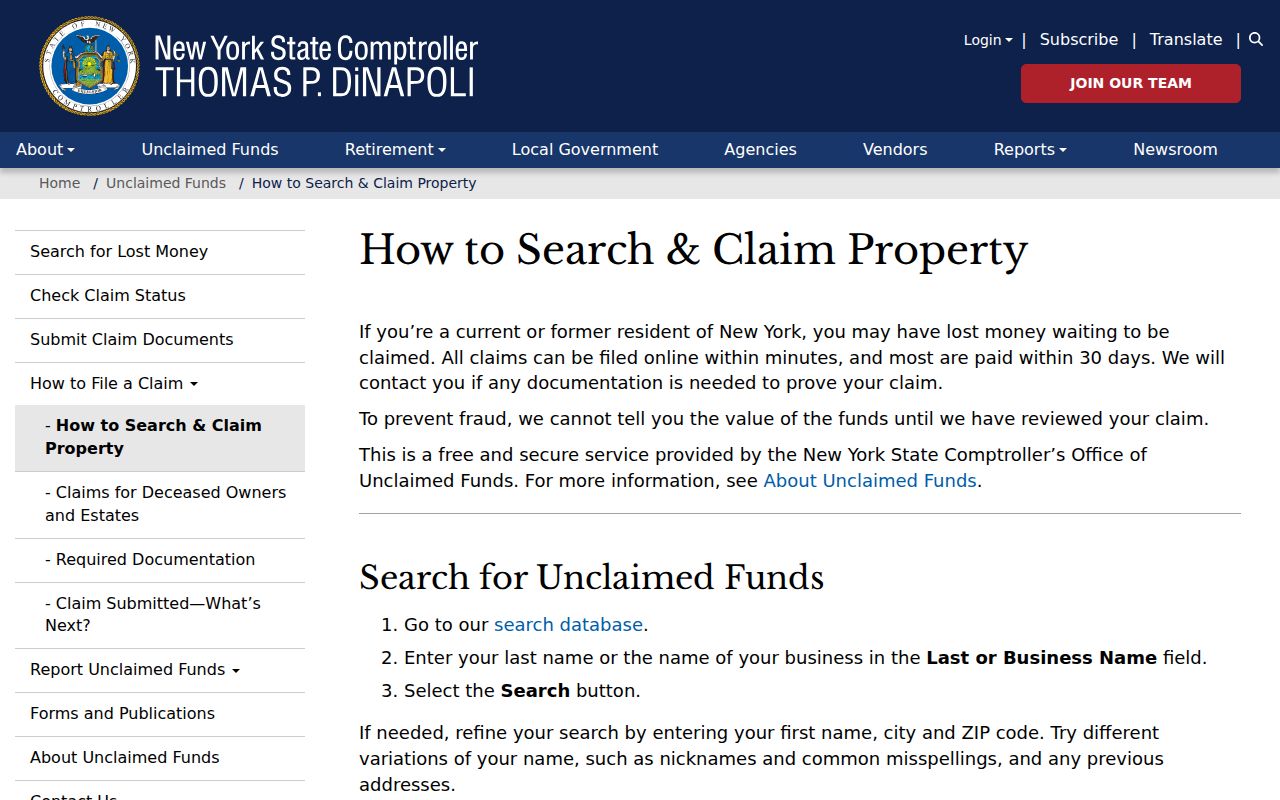
Those fields serve a claimant inquiry. The separate claim process and the state record's own date keep this tool apart from an Onondaga resident record, since a funds match and a household listing answer two different questions.
Historical Onondaga Directory Evidence
Onondaga history sits on overlapping timelines. County land records open in 1794. The library's Syracuse directory run begins in 1844, and telephone directories follow in 1894. Some library volumes are digitized. Many more sit on fiche, film, or paper. Others need staff help to read. The County Clerk's digitization has targeted remaining mortgages from 1794 to 1950 and numerical deed and mortgage indexes from 1799 to 1986. Any historical Onondaga residents directory trail should therefore check live eSearch availability. Not every old image sits online.
For each household, record the directory title, year, publisher, page or image, street, and exact printed name. Pair it with a deed, obituary, or census source that carries its own date. The Onondaga city directory collections page maps the shelves. It also explains the reading method in full. A Syracuse title never covers a Town.
Note: A missing name can mean an omitted volume, a rural gap, a household-head-only listing, an alternate spelling, or an unindexed scan.