
Onondaga City Directory Collections
The main shelf for an Onondaga historical directory search is Onondaga County Public Library Local History & Genealogy at the Central Library. Its holdings are strongest for Syracuse and the county, so a Town result must be checked against the street, hamlet, and municipality printed in the source. The library reports a Syracuse run from 1844 to the present, with some missing years. That is a valuable lead for an Onondaga family, but the title of a Syracuse volume does not promise that a Town of Onondaga household appears in it.
| Collection | Years | Where Held | Access |
|---|---|---|---|
| Syracuse print directories | 1844-present, with gaps | OCPL Local History & Genealogy | Microfiche, microfilm, or paper by year |
| Digitized Syracuse directories | Through 1923 | FamilySearch catalog | Item-level digital access varies |
| Suburban and Syracuse print directories | 1936-present | OCPL Local History & Genealogy | Library and staff-query route |
| Telephone directories | 1894-present | OCPL Local History & Genealogy | Onsite or bounded staff request |
Use the collection name as a coverage claim, not a conclusion. Search a known Town street, a hamlet such as Onondaga Hill or Nedrow, and a county phrasing before treating a missing entry as evidence that the person was absent.
Onondaga City Directory Coverage
An Onondaga historical search starts with a place check because Syracuse is both the county seat and a postal label used for Town addresses. OCPL advises using geographic and jurisdiction terms in its catalog. Try Town of Onondaga, Onondaga County, a named hamlet, and the exact street. A city volume may contain a nearby business address or a suburban listing, while another year may omit the Town altogether. Compare a known Town address from the same year before relying on a negative result.
The OCPL directory-holdings guide makes the format breaks visible. It is also a good starting point for asking staff which source belongs to a particular year.
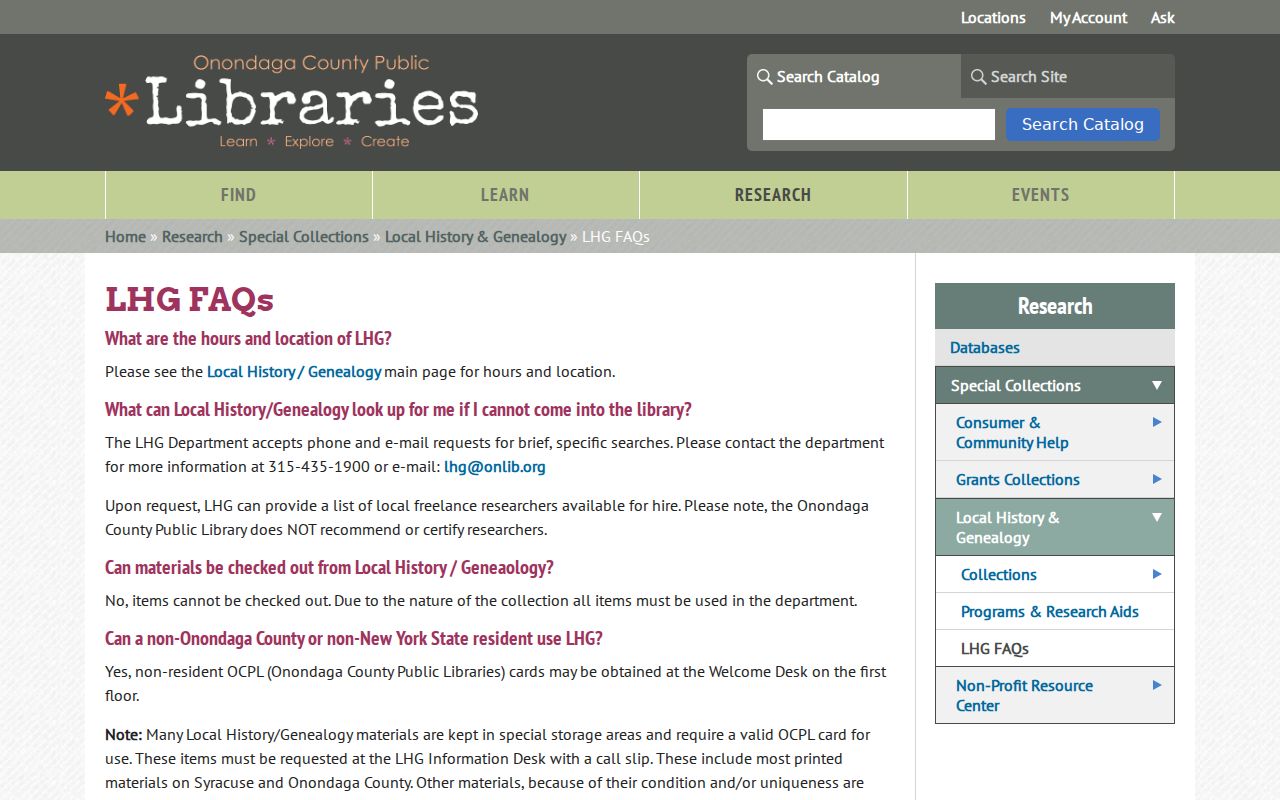
The holdings view helps plan a visit or a narrow request. It does not turn the Syracuse title into direct Town coverage.
OCPL Onondaga Directory Formats
The physical form changes the way an old Onondaga volume is used. OCPL lists 1844 through 1860 on microfiche, 1862 through 1935 on microfilm, and 1936 to the present in paper form. The missing transition years and the overall gaps matter. A familiar name may be absent because there is no volume, the volume lacks Town coverage, a household head alone was printed, or a scan was not indexed.
Keep a small source timeline with the answer. These are separate formats with separate access paths, not one uninterrupted online name database.
- 1844: First year in the reported Syracuse run at OCPL.
- 1850: Beginning of OCPL newspaper microfilm holdings.
- 1894: Beginning of OCPL telephone-directory holdings.
- Through 1923: Digitized directory access reported through FamilySearch.
OCPL Local History & Genealogy is on the third floor of the Central Library, 447 South Salina Street, Syracuse, NY 13202-2494. Its listed hours are Monday, Thursday, Friday, and Saturday from 9 to 4:45, and Tuesday and Wednesday from 9 to 7:15. Staff assistance, an OCPL card, and nonresident cards at the welcome desk provide useful access routes when a film, fiche, or paper volume is not available from home.
The service desk is a practical place to ask whether a particular year is on fiche, film, paper, or a separate suburban source before ordering copies.
Note: A directory absence is a research gap until the volume, geography, spelling, and household listing practice have all been checked.
Onondaga City Directory Scans
FamilySearch provides a digitized Syracuse directory for 1881-82, listed as a 358-page item with identifier 2477517. OCPL says directories through 1923 have been digitized there. Record the exact item, page, and access status in research notes, because a catalog record does not mean that every item opens in the same way at every location.
A FamilySearch directory record is useful for checking a printed page against a name index or a staff transcription.
Use the scan as a historical image, then identify whether the displayed address lies in the Town, the City, or another nearby jurisdiction.
Reading an Onondaga Directory Entry
A directory entry is a dated publication record, not proof of present residence. Capture the printed form of the name, street number, street, year, title, page, publisher when given, and the film, image, or item identifier. An occupation or business line can help distinguish two people with the same name, but it remains a locating clue. Directory practice differs by volume, and an entry can represent a household head, business, institution, boarder, or telephone subscriber.
| Printed name | Preserve spelling and initials exactly as shown. |
|---|---|
| Street line | Record the number and street before normalizing a modern address. |
| Household notation | Note boarding or household language only when the volume prints it. |
| Business or telephone line | Use as a date-specific clue, not a home-address claim. |
| Source citation | Include title, year, page, format, and coverage note. |
- Criss-cross directory
- A directory section arranged by street and number, when a particular volume supplies one.
- Householder listing
- An entry that names one person for a household rather than every person there.
- Abbreviation key
- The volume's explanation of shortened labels; read it before expanding any mark in an entry.
Onondaga Telephone Directory Clues
When the print-directory trail is thin, OCPL has telephone directories from 1894 to the present, newspaper microfilm from 1850 to roughly three months before the present, and a Syracuse newspaper obituary index for about 1860 through 1996. Newspapers can add a former address, family relationship, funeral location, church, cemetery, or migration clue. Each statement needs its own date and source label.
OCPL's additional-source list also identifies WPA files, the Onondaga Pioneer Index for pre-1850 settlers, and family vertical files. OCPL staff accepts bounded queries by email, mail, or phone. Its published guidelines describe a microfilm search of five days for $5 and copies at $0.25 per page plus $1 mailing, so a request should name a person, date range, and source rather than ask for every record on a common name.
Onondaga Family History Shelves
The Town of Onondaga Historical Society and Museum can supply context that a print directory cannot. The Historical Society identifies burial records, photographs, newspaper articles, census material, county poorhouse material, and local family resources. The museum at Town Hall, 5020 Ball Road, holds family histories, diaries, scrapbooks, church and burial records, maps, photographs, and Poor House Ledgers from the 1830s through the 1960s. It is open Tuesday and Thursday from 1 to 3, Wednesday noon to 3, and by appointment Monday through Friday from 9 to 3:30.
The Partridge Family Collection on NY Heritage is a particularly useful bridge between a printed name and local history. Its more than 350 digitized items include deeds, mortgages, receipts, letters, school essays, and town-commissioner documents. Ask the museum for a finding aid and permission before reproducing names or images.
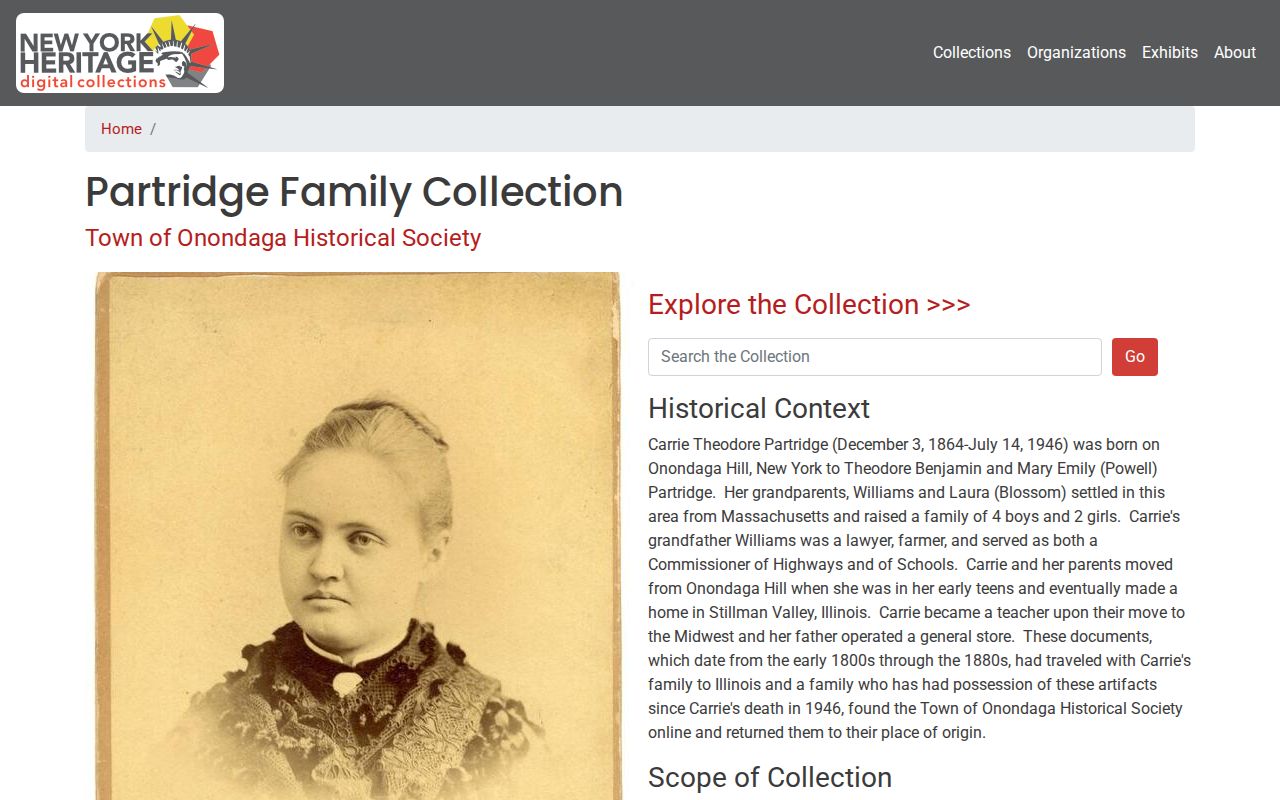
The collection can supply a family or address lead, while the directory or County Clerk instrument supplies the date-specific record needed to confirm it.
The Onondaga Census Index Note
A Town newsletter from Fall/Winter 2022-23 reported that the 1855 New York State Census for the Town of Onondaga had been completely indexed and was not then available on Ancestry or FamilySearch. That is a dated newsletter statement about availability at publication, not a claim about what a catalog offers today. Treat it as a reason to ask the Historical Society or museum for the current access route.
The same caution applies to every historical catalog. A microfilm, transcription, original, digitized image, and family compilation do not carry the same coverage or evidentiary weight.
Tracing Onondaga City Directories
Trace a household through one volume at a time, then connect moves to independent dated records. The directory collections stay at the center of this task, while a backward address chain belongs on the Onondaga previous residents search resource.
- Start with the earliest confirmed spelling and a directory year close to the known event.
- Copy the printed street, number, page, and coverage note before searching the next year.
- Test a hamlet name, a county search, and a street search when the Syracuse volume does not produce a Town hit.
- Pair the dated directory entry with the relevant census, tax, or assessment record for that period.
- Use obituary, cemetery, church, or poorhouse material to explain a move, death, or family connection.
Do not guess why a name disappears. The person may have moved, died, changed spelling, been omitted as a non-householder, or fallen outside the volume's Town coverage.
Citing Onondaga Directory Evidence
County land records reach back to 1794, yet historical names do not form a continuous list. Publication formats, street names, postal conventions, parcel identifiers, and custody changed over time. OCPL preserves fiche, film, paper, newspapers, phone books, and family files that may not be searchable online. The County Clerk, library, museum, Historical Society, and NYS Archives each answer different questions.
A sound citation includes the year, source type, title, page or item, exact printed address, and a short coverage warning. For an old Town search, note whether the result is an original, index, scan, transcription, or staff statement. A library family file can preserve a clue, but a County Clerk instrument is the legal confirmation for a transfer. A newspaper notice supplies context, while an obituary preserves author language. Keeping the source type with the fact lets a later researcher test, refine, or correct the conclusion.