
Finding Onondaga Resident Records
There is no official master list of Onondaga households. The useful path depends on the detail in hand. An exact street address belongs first with the assessment roll and parcel map. A full name and a past year work better in library directories, newspapers, and family files. A tax-map number or deed book and page leads to the County Clerk. Each result answers a narrow question, such as recorded ownership, a dated directory entry, or a registration response. It does not by itself prove that a person lives at an address today. An Onondaga residents directory result is only as strong as its source and date.
Keep the record type visible as the search moves. Onondaga has a special postal trap: Town Hall and many town offices use a Syracuse, New York 13215 mailing label. That delivery label is not City of Syracuse jurisdiction. Confirm the municipality with the parcel, tax-map number, GIS layer, or town office. For older names, test the Town of Onondaga, a hamlet, and Onondaga County as well as Syracuse in the library catalog.
- For an address, use the county assessment search and record the situs, mailing field, tax-map ID, roll year, and deed book/page.
- Open the GIS parcel view to check the municipality and surrounding parcel geometry before treating a postal city as a jurisdiction.
- Use the County Clerk index for the recorded document trail, then ask the Clerk about an image or copy when the index is not enough.
- For a past household, ask OCPL Local History & Genealogy for the appropriate directory, telephone-book, obituary, or newspaper run.
- Request an existing town or county record by series, address, and date range when no online index covers it.
Note: A no-result can reflect a spelling variant, a coverage gap, a sealed record, or an index that has no image.
Onondaga Offices Behind Resident Records
Different custodians keep different parts of the Onondaga record trail. The Town assessor reconciles a local parcel and assessment question. The County Clerk maintains land records and the related index. The Board of Elections administers election records and the state lookup. The Town Clerk handles municipal files and the Town FOIL route. That split is why an Onondaga residents directory search should start with the office that created the record rather than asking another office to assemble a new resident list. For an address-by-address method, use the Onondaga street directory.
Onondaga County Clerk
401 Montgomery Street, Room 200
Syracuse, NY 13202
315-435-8250, Real Property
Onondaga County Board of Elections
1000 Erie Boulevard West
Syracuse, NY 13204
315-435-8683
Onondaga Parcels Before Names
The county's Image Mate assessment search is often the cleanest first stop for an address. Its own guidance says to enter one search item, then refine. A parcel record can lead to a tax-map number, owner of record, situs address, owner mailing address, assessment data, and a deed book/page. The Town assessor is the local verification point because county information comes from town assessors and can change during the year.
| Image Mate field | How to use it in Onondaga |
|---|---|
| Tax Map Number | The strongest stable parcel key when an address has changed or a name is common. |
| Owner Name | Enter the name as the deed or roll shows it, then test a surname variant if needed. |
| Property Address | Use the physical situs, not a mailing address, to begin an address search. |
| Mailing Address | Labels a delivery address for the owner and must not be treated as the parcel location. |
The parcel card is a dated assessment snapshot. It can show an owner field, but it does not list every person at the property. The deed book/page is the useful bridge to the Clerk's index.
Onondaga Deed Index Trail
The County Clerk eSearch provides a free guest route to its index. Document images require an account, subscription, or a counter/copy route, and not every historic index entry has an image. Recorded land records reach back to 1794. That span is valuable for estate and family-history work, but it is not one modern address search. Older entries can use names, legal descriptions, book/page references, and handwriting that need patient variant searches.
A deed records a transfer of an interest. It is evidence of a dated ownership event, not a census of occupants. A mortgage records financing, and an easement or right-of-way does not transfer ownership. When a compound surname seems absent, the Clerk's published tip is to try the second component with the Last Name set to Contains, except for the stated post-August 21, 2017 limitation.
- Parcel
- A tax-defined piece of land identified by a tax-map number, not a list of everyone who lives there.
- Grantor and grantee
- The party transferring an interest and the party receiving it in a recorded document.
- Index
- A finding tool that points to a record. It may not include the document image.
- Criss-cross directory
- A historical directory arranged by address, useful for dated household research when a library holds one.
Onondaga Voter Records Have Limits
The state voter lookup asks for county, last name, first name, date of birth, ZIP code, and address information. It is designed for an individual's registration and polling information, not for building a household roster. Election Law §3-220 makes registration records public under Board supervision while keeping driver-license, non-driver ID, Social Security, and facsimile numbers closed.
Use a return from the lookup as limited, dated civic corroboration. A result can be stale, protected, or affected by list maintenance. Record the access date, do not repeat protected identifiers, and ask the Board of Elections about an existing report or district record when an online result is not enough.
Current Onondaga Resident Sources
Current-looking sources still have different scopes. Assessment records organize land and ownership. The voter service is an individual registration route. The Clerk index organizes parties to recorded documents. Court, license, jail, registry, and business sources each have another purpose and may contain a name without showing current residence. An Onondaga residents directory search is more accurate when the source label stays beside the name and date. It is not a promise that every household can be found.
| Source | Who It Lists | Keeper | Access |
|---|---|---|---|
| Image Mate roll | Assessment owner and parcel fields | Town assessor / county display | Public search, verify locally |
| NYS voter lookup | Limited individual registration and polling information | Board of Elections | Public lookup with field limits |
| Clerk eSearch | Grantors, grantees, and recorded document parties | Onondaga County Clerk | Guest index free; images limited |
| Town records | Existing minutes, permits, clerk files, and notices | Town departments and Clerk | Department, counter, or FOIL route |
| Public-safety tools | Time-sensitive custody or statutory registry information | Sheriff or state agency | Restricted by purpose and rules |
Use the roll for a parcel question, the Clerk for a recording question, and the library for a dated household question. When the goal is to test whether two records refer to the same person, the Onondaga resident lookup method keeps address categories, dates, and name variants separate.
Onondaga Names at OCPL
OCPL Local History & Genealogy at the Central Library is the core shelf for older Onondaga names and addresses. It holds Syracuse directories from 1844 forward, though some years are unavailable, plus telephone directories from 1894 forward, newspaper microfilm, an obituary index, WPA files, the Onondaga Pioneer Index, and family vertical files. Ask for the town, hamlet, county, and street rather than relying on a Syracuse label alone.
Formats change the search plan. The directory run is microfiche for 1844 to 1860, microfilm for 1862 to 1935, and paper from 1936 forward. Volumes through 1923 have a FamilySearch digitization route. A library entry is evidence for the volume year and printed address, not a claim about a person now.
Onondaga Museum Family Trails
The Town of Onondaga Historical Society adds local materials that ordinary directories do not capture. Its museum at Town Hall has family histories, burial and church records, maps, diaries, scrapbooks, photographs, and Poor House Ledgers dating from the 1830s through the 1960s. Requests work best when they give a full name and variant, an approximate year, a hamlet or street, and a narrow question. The museum asks researchers to seek permission before reproducing material.
The digitized Partridge Family Collection is a particularly local bridge between documents and family history. Its more than 350 items include deeds, mortgages, receipts, letters, school essays, and town-commissioner material. It can help a family researcher locate a name or event, but it should be paired with a Clerk document or other custodian record for legal confirmation.
Onondaga Court and Vital Checks
Court and vital records are verification tools, not general household lists. The New York courts' WebCivil/eCourts and NYSCEF routes can help locate a case by permitted name, case, court, county, and date fields. A court address may be a service, mailing, attorney, or property address. Save the case number, party role, filing date, and disposition, then ask the assigned court for the correct document route. No official online party-search screen was located for the Town Justice Court, so phone or in-person contact is the documented route there.
For genealogy, Onondaga County Vital Statistics and the New York State Department of Health have separate products and request rules. Birth records need to be at least 75 years old with the person known deceased, death records 50 years old, and marriage records 50 years old with both spouses deceased for ordinary genealogy access. OCPL can help with an index, but it does not hold the certificate. Send a precise record type, place, date, relationship, and proof through the appropriate custodian.
Onondaga Records With Lawful Gaps
New York Freedom of Information Law, Public Officers Law Article 6 §§84-90, provides a route to existing agency records. It does not require an office to create a new research compilation. A practical Town request identifies the record series, street address or tax ID, date range, and desired format. The Town FOIL form also has its own certification about noncommercial, nonsoliciting, and nonfundraising use. For records not online, the counter, phone, mail, library, archives, and FOIL are part of the access chain, not afterthoughts.
Some results are properly hidden or incomplete. The New York Address Confidentiality Program under Executive Law §108 can substitute an address for eligible participants. Sealed adoption and court records, protected election fields, motor-vehicle data, and restricted public-safety material are not gaps to work around. Treat an absent result as a source limit unless a custodian confirms more.
Onondaga Name Matches Need Context
A shared name and ZIP code do not identify one person. Track the full name, middle initial, former surname, spelling variant, approximate date, municipality, and record role. Then use two independent custodians when possible. A deed plus an assessment roll can support a dated ownership chain. A directory plus an obituary or cemetery record can support a historical association. A court or business result should retain its separate purpose and address category.
Write conclusions narrowly: “assessment owner at roll date,” “directory entry in volume year,” or “voter lookup returned on access date.” A parcel situs, owner mailing address, deed address, directory address, and public-record substitute address are not interchangeable. This is especially important in Onondaga, where postal Syracuse can appear on a Town record.
Onondaga State Name Searches
New York's unclaimed funds search is a useful example of a name-based state service with a different purpose. It can use last or business name, first name, city, ZIP, and a property ID. A match identifies a possible state-held claim, not a current address or resident status. Keep the result within that purpose and use the state claim procedure rather than treating it as a directory record.
The state also has business and license searches, but their service, practice, or registered addresses should never be relabeled as homes. Official tools can be useful for checking a dated public association when the record purpose fits. They do not turn a name match into proof that the person is part of an Onondaga household.
The official New York unclaimed funds search illustrates the available name, city, ZIP, and property-ID fields.
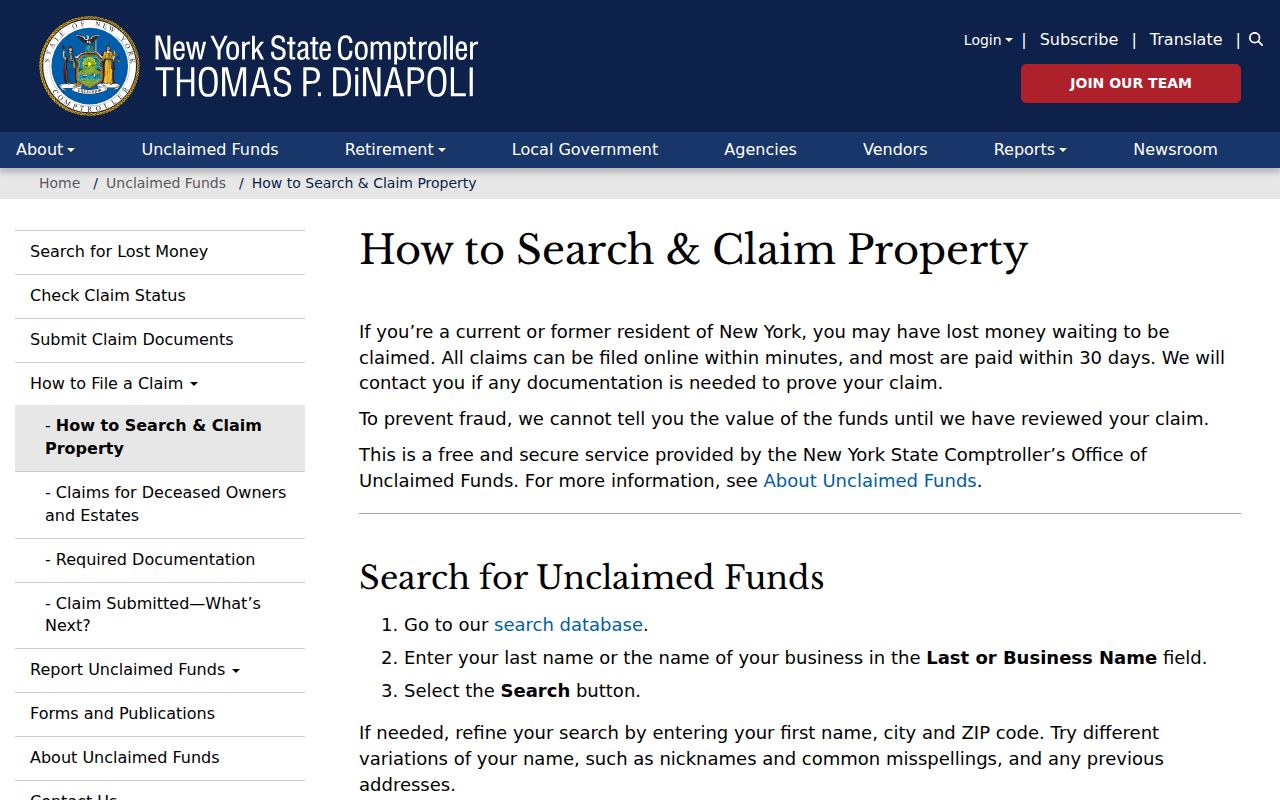
Its fields are useful for a claimant inquiry, while the separate claim process and date of the state-held record keep it distinct from an Onondaga resident record.
Historical Onondaga Directory Evidence
Onondaga historical research works across overlapping timelines. County land records begin in 1794, while the library's Syracuse directory run begins in 1844 and telephone directories begin in 1894. Some library volumes are digitized, but many remain fiche, film, paper, or staff-assisted resources. The County Clerk's digitization work has targeted remaining mortgages from 1794 to 1950 and numerical deed/mortgage indexes from 1799 to 1986. An historical Onondaga residents directory trail should check live eSearch availability instead of assuming every historical image is online.
For a household, record the directory title, year, publisher, page or image, street, and the exact printed name. Pair it with an assessment, deed, obituary, cemetery, or census source that has its own date. The full collection and reading method are available through the Onondaga city directory collections, which explains the local shelves without treating a Syracuse title as automatic Town coverage.
Note: A missing name can mean an omitted volume, a rural coverage gap, a household-head-only listing, an alternate spelling, or an unindexed scan.